In this article
Most manufacturers in Punjab run plants that look enormous from the road and tiny online. A buyer in Karachi or a distributor in Lahore opens the website, sees a stock photo of a wheat field and a gallery of blurry phone pictures, and decides you are smaller than you are. Corporate video production in Multan fixes this, because the scale is already there. Somebody just has to film it properly.
That was the brief from Boota Brothers Flour Mills, a Punjab flour milling group. They needed a modern website that shows the scale of the operation to buyers and distributors. We built the site on Webflow at bootagroup.com and sent our crew to the mills for an on-site drone and video shoot, so every screen of the site runs on real footage instead of stock. This post walks through how we planned it, what we filmed, and what any factory, mill or plant owner can copy.
The Boota Brothers project at a glance
From the Boota Brothers case study and the website film.
Quick answers
What does corporate video production for a manufacturer include?
At minimum: a brief, a shot list, an on-site shoot day covering the plant, process and people, and an edit cut for every place the footage will live. For Boota Brothers that meant drone footage for the website hero, ground shots of each mill, and a vertical website film for social. The point is one shoot that feeds many screens, not one video that sits on YouTube.
Is drone videography worth it for a factory or mill?
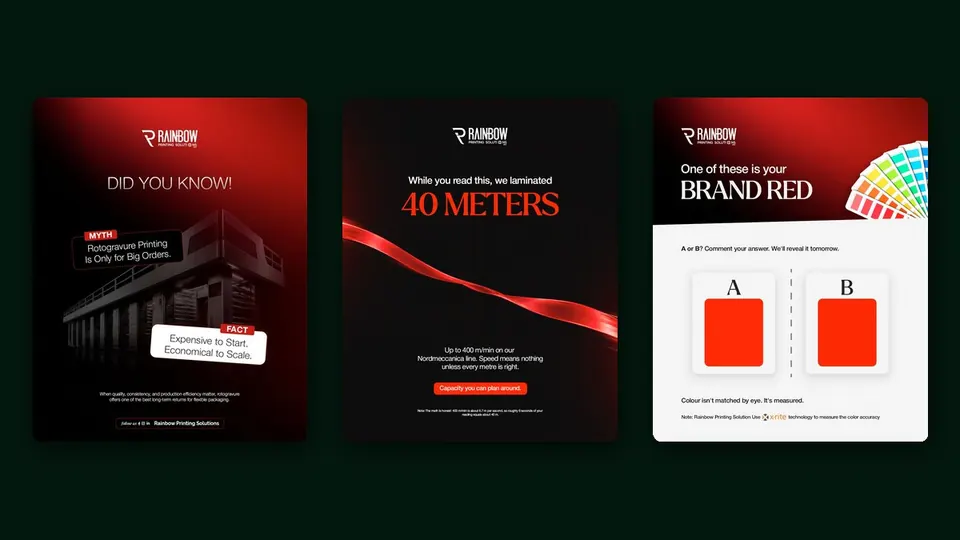
For most plants, yes. Scale is the hardest thing to show from the ground and the easiest to show from the air. One aerial shot tells a buyer how big the site is, how organised it looks and that the business is real, in about two seconds. Rainbow Printing Solutions, another manufacturer we work with, uses an aerial shot of its solar operated facility for exactly that reason.
Do you need a Multan based crew to shoot in Punjab?
It helps. Our crew is based in Multan and shoots on location across Pakistan, so a mill or factory anywhere in South Punjab is a normal shoot day, not a travel project. Brands outside Pakistan can also send their own raw footage and we handle the edit, colour, motion and sound remotely.
Why manufacturers need corporate video more than anyone
For a manufacturer, credibility is visual. A buyer wants to see the plant, the process and the people before they trust you with a contract. A restaurant can win on a good burger photo. A flour mill wins on proof that it can deliver the same quality at volume, every month, for years.
Text cannot do that job. "State of the art facility" appears on every manufacturer's website in Pakistan and nobody believes it. A drone rising over the mill, the production floor running, sacks moving off the line: that is believable, because it is hard to fake.
There is a second reason. A buyer abroad will probably never visit your plant. The website and the films are the factory tour. If they look cheap, your business looks cheap, whatever your capacity is.
How we planned the Boota Brothers shoot
The most important decision on this project was made before anybody picked up a camera: the brand film and the website were planned together, so the story matched on every screen. Most businesses do these separately. A web developer builds a template and fills it with whatever photos exist, then a year later someone shoots a video that matches nothing on the site. We did it the other way round.
Our corporate video process
The same four stages we use on every brand film, from the video production service.
Here is how the shot list mapped to the site.
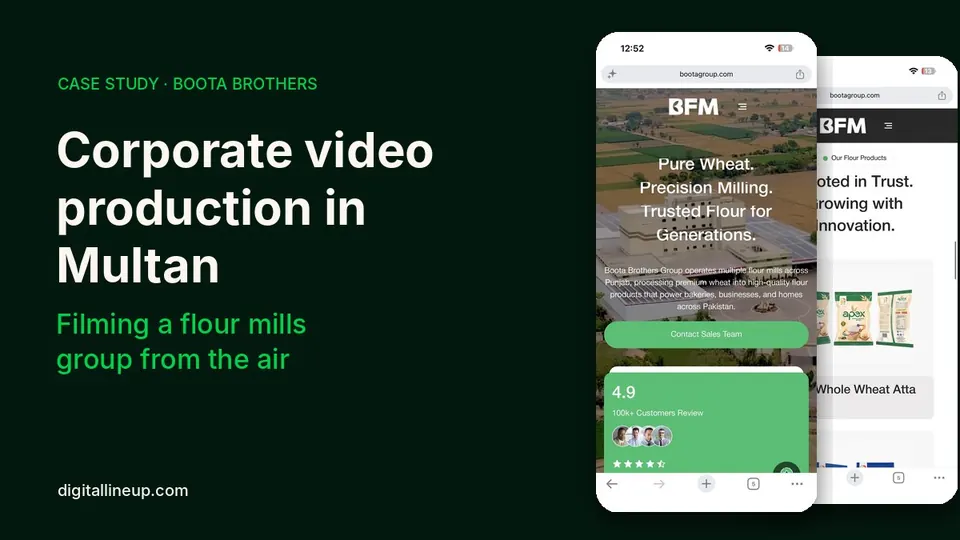
An aerial film as the first impression. The homepage opens on drone footage of the mill and the fields around it, with one headline over it: "Pure Wheat. Precision Milling. Trusted Flour for Generations." A visitor understands the size of the business before they read a word of the body copy.
Four mills, one swipe. Boota Brothers operates four mills, so we gave each one its own card with real photos from the site, laid out as a carousel. On a phone, a distributor swipes through the whole operation in a few seconds.
Certified trust. The certification badges sit high on the page, right under the hero. Certificates are proof, and proof belongs near the top, not on a page nobody clicks.
A timeline since 2008. "A journey of growth" turns the company history into milestones, such as the 2014 expansion with a new milling facility, shown with real photos of the site. It answers the buyer's quiet question: will this supplier still be here in five years?
Real reviews, and the name at full scale. Reviews sit on the page as social proof, and the footer runs the company name as a large brand marquee. Small details, but they make the site feel like a serious group, not a small mill.
You can see the site on mobile and the film on the Boota Brothers case study.
What to film at a factory or mill
If you are planning corporate video production in Multan or anywhere in Punjab, this is the shot list I would start from for any plant. It is the same thinking we used at the mills, at Rainbow Printing and on our showroom shoots for Hamid Enterprises.
The wide aerial. One clean drone shot rising over the site, ideally in early morning or late afternoon light. This becomes your website hero, your LinkedIn banner video and the first second of your brand film.
Each site or unit. If you have more than one mill, warehouse or plant, film each one the same way, from the same angles, so they read as one group. Consistency looks like scale.
The process, close up. Machines running, product moving, hands at work. Close-ups make an industrial process feel precise. Rainbow's feed works because it shows a press running at full speed, not a brochure of one.
Quality control. Lab tests, checks and inspections. Buyers worry about consistency more than anything else, so show them the step that protects it.
People. Your team on the floor and your management team. Buyers trust people, not buildings.
The product in use. For a flour mill, that is flour turning into bread on a family table. For packaging, it is the pack on a shop shelf. The end use is what your buyer sells, so show it.
One shoot, many screens
The mistake I see most often is a business paying for one long corporate video that sits on YouTube with a few hundred views. A shoot day is expensive because of the crew, the kit and the time at the location. The edit is where you get your money back.
From the Boota Brothers shoot, the footage feeds the website hero, the mill cards, the timeline photos and a 32 second vertical website film made for Instagram, TikTok and Facebook. That film walks through the site section by section: four mills, certified trust, since 2008, real reviews. It works as a launch post for the client and as a portfolio piece for us.
That is how we plan every film now. The same shoot works as a brand film, a reel and an ad, because we cut a version for every platform. Across four years our team has produced 1,000+ videos, reels and assets this way, and our client work has passed 100M+ total views, including one creator film for Apex Solar that reached 11M views on its own.
Mistakes manufacturers make with corporate video
Shooting before planning. If the crew turns up without a shot list, you get pretty footage you cannot use. Decide where every shot will live first.
One long film, no cut downs. A five minute company profile is fine for a sales meeting. Online, people need a 15 second hook. Always ask for vertical cuts.
Stock footage of somebody else's factory. Buyers can tell, and it quietly says you have something to hide. Your real plant, even on an ordinary day, is more convincing.
A website that cannot show video. Heavy, slow templates make footage stutter on a phone. Boota's site was designed mobile first on Webflow so the footage loads cleanly where most buyers will see it.
Filming only the building. A drone shot of a roof is not a story. Pair it with the process, the people and the product.
What to take away
- Corporate video for manufacturers is proof of scale, and scale is easiest to show from the air.
- Plan the film and the website together so every section of the site has the footage it needs.
- Write the shot list before the shoot day: aerial, each unit, process, quality, people, product.
- Cut every shoot for every screen: website, reels, ads and LinkedIn.
- Use real footage only. Your actual plant beats stock every time.
We do this end to end through our video production service, and when the footage needs a home, our website design service builds the site around it. If you are a B2B company wondering what to post once the films are done, our guide to LinkedIn marketing in Pakistan shows how we turn factory content into a feed buyers follow.
If you run a mill, factory or plant and your website still looks smaller than your business, message us on WhatsApp. Tell me where the site is and I will tell you what I would film first.
Want this for your brand?
Video, brand identity, Meta ads and social media, made in-house by our team in Multan. Tell us what you are building.

Founder of Digital Lineup, a content production and digital marketing agency in Multan, Pakistan. Four years of brand films, Meta ads, identities and social media for brands in Pakistan and Australia.