In this article
Most TV mounting and picture hanging businesses we speak to have the same story. Great reviews, happy customers, and a phone that goes quiet for weeks at a time. They have tried boosting a post or running a few ads, and either the money disappeared or the leads were tyre kickers who wanted a $50 job done for free.
This is a breakdown of one Perth installer we worked with from April to August 2026. We delivered the account through a partner agency, so we cannot name the business, and the branding on the creatives is blurred. Every number below comes from the Meta Ads report.
Five months at a glance
One Perth TV mounting and picture hanging business, April to August 2026. All figures in AUD.
Quick answers
How much does a lead cost for a TV mounting business on Meta ads?
For this Perth installer, the whole-account cost per lead went from $119.63 in April to between $29.57 and $46.18 a month from May to August 2026. The best single campaign reached $25.14 per lead in July.
How long do Meta ads take to work for an installer?
The first month was mostly fixing tracking and campaign structure. Leads jumped from 9 to 71 in the second month and kept climbing to 135 by the fifth month.
What ad creative works best for TV mounting?
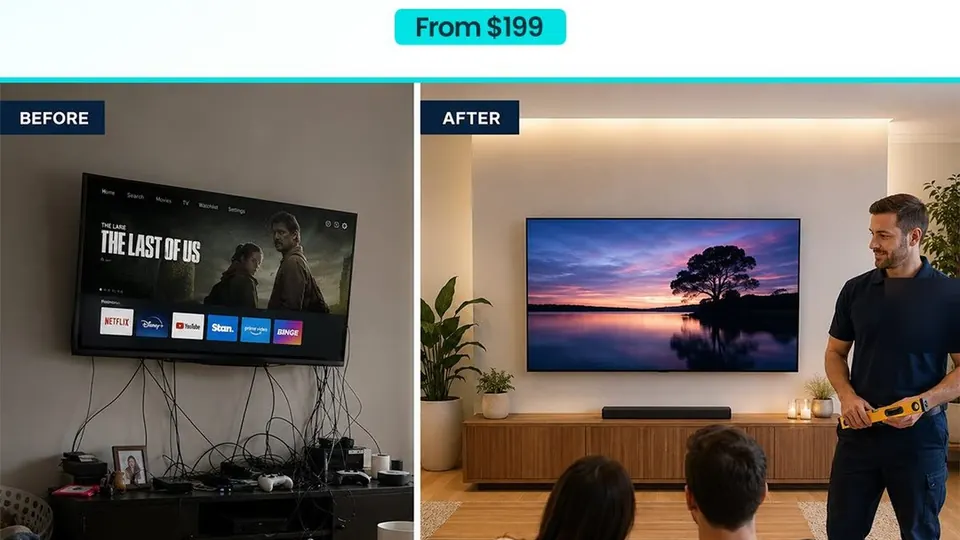
Before-and-after images and finished-room shots. In June the before-and-after ad set ran at about $29.50 per lead, while an ad built around a photo of the installer ran at $37.28.
The numbers, month by month
| Month (2026) | Leads | Cost per lead (whole account, AUD) |
|---|---|---|
| April | 9 | $119.63 |
| May | 71 | $40.54 |
| June | 64 | $46.18 |
| July | 109 | $29.57 |
| August | 135 | $32.17 |
Two things to notice. First, the jump from April to May is mostly tracking and structure, not magic creative. Second, cost per lead did not fall in a straight line. June went up, and August went up slightly as we pushed more volume. That is normal. When you scale spend, the cheapest leads get used up first. What matters is that lead volume kept climbing while cost per lead stayed in a range the business could afford.
The main lead campaign on its own reached $25.14 per lead in July. The whole-account figure is higher because it includes every campaign in the account.
What we actually changed
The setup, in order
Seven changes, roughly in the order we made them.
1. A fresh pixel, tracked properly, then warmed up
The old setup could not tell Meta which visitors actually asked for a quote. So Meta optimised for clicks and cheap traffic, not for people who wanted a TV on the wall this week. We set up a fresh pixel that fires on real quote requests and gave it time to learn before scaling spend. Everything else depends on this step.
2. Lookalike audiences built from real leads
Once real leads were flowing, we built lookalike audiences from the people who had actually asked for a quote, not from page likes or website visitors. A lookalike of buyers beats any interest you can tick in Ads Manager.
3. Campaigns split by service
TV mounting, picture hanging and "all services" each got their own campaign, budget and ads. Someone looking for a gallery wall and someone mounting an 85-inch TV are different people with different jobs and different budgets. Splitting them let us see which service was actually profitable and move money there.
4. Creative that shows the finished wall
This was the biggest creative lesson. In June, the before-and-after ad set was running at about $29.50 per lead, while an ad set built around a poster of the installer was at $37.28. We paused the installer poster.
People do not buy an installer. They buy a clean wall with no cables hanging down. Before-and-after images, finished rooms and short install reels consistently beat "meet the team" style ads.
When we added video, we put it into the winning before-and-after ad set as a second creative instead of launching new ad sets. That let Meta share the budget between the static ad and the video without restarting the learning phase.
5. A landing page that does not leak
The landing page had over 500 reviews, but they were not visible above the fold. We moved trust signals to the top, kept the quote form short and easy to fill in on a phone, and added a sticky call-to-action so the button is always on screen. Most installer leads come from mobile, often from someone standing in their living room looking at the wall.
6. A steady content engine
We ran a plan of 22 posts a month plus install reels. Before anyone fills in a quote form, they check the Facebook or Instagram page. An active page with real jobs on it turns a curious click into a lead.
7. Monthly reporting in plain English
Every month the owner got one report: leads, cost per lead and spend, plus what we would change next month. No 40-slide decks.
What this means for your installation business
If you run a TV mounting, picture hanging, mirror or shelf installation business in Australia, the same rules apply:
- Fix tracking first. If Meta cannot see real quote requests, it cannot find more of them.
- Split campaigns by service so you know which jobs are actually making money.
- Show the result, not the installer. Before and after, finished rooms, short reels of real jobs.
- Make the landing page work on a phone. Reviews at the top, a short form, a button that never leaves the screen.
- Judge it over months, not days. The first month here was mostly setup. The results came after.
Want to see where your own ads stand? Run them through our free 12-point Meta Ads Checklist: it takes two minutes and gives you a score.
How we work with installers
You own your ad account and pay Meta directly. We bill monthly in Australian dollars and there is no lock-in. Our team is in Multan, Pakistan, and works through your afternoon and evening, so new ads and videos are usually ready by the next morning.
If you want the full numbers, the packages and a one-minute intro from me, they are on our page for installers.
Run an installation business in Australia?
See the full numbers and how we work with installers, or email us your website for a free 2-minute video on what we would fix first.

Founder of Digital Lineup, a content production and digital marketing agency in Multan, Pakistan. Four years of brand films, Meta ads, identities and social media for brands in Pakistan and Australia.